skip to main |
skip to sidebar
Heh! That got your attention!
I've spent a week doing some teaching at another college to help out an old friend. So far - and it's only Thursday yet - I've had to explain to them that if you don't do the work, you don't get marks (living with the consequences), been aggressively reprimanded by a student for using "foul, and offensive language, too disgusting to repeat" (what I actually said was "bugger that for a lark!"), and been harangued by an arrogant young man who tried to hijack today's session to expound in detail his view that "the Word of God" says that "man is the head of woman" and that women should therefore submit to men (I invited him to leave the room, since women are not to teach men, apparently, but he didn't take the bait).
I feel so very sorry for some of them. The need to lay hold of an immutable Truth and take refuge in pious certainties overlies a terrible fear of contingency, human messiness and failure. I can't seem to penetrate the shell of anger and defensivness. But there's no light in there. I saw a poster a few days ago which seems apt: Blessed are the cracked, for they let in the light.
So where does sex come in? Ah, yes. I showed excerpts from three films, two of which are rated 15, and only one of which is rated 18, of men in gay relationships. I bet you can guess how that went down?
After a full day's teaching there each day, I'm belting back across the city to do another couple of hours in my own college because my boss is signed off sick for 9 weeks. And then each evening, I'm coming home to do some work on a module revision for yet a third college. Will somebody please remind me why I wanted to be an academic?
Ah, I remember. Monday evening! Back in my own institution for a few hours teaching some urban contextual theology, I was able to deliver a seminar session on the CULF report, released from embargo only 6 hours earlier. A colleague had been one of the select few to have a pre-embargo copy, and she handed it to me just as 12 noon struck, giving me time enough to read it and prepare some teaching notes before my students arrived at 6. We like to be up to the minute.
On the plus side, my remortgage is nearly completed. This means I will own the house myself (with a little help from the building society)  and can get on with some home improvements. I'm getting quite lightheaded (unless it's the tiredness, of course) over whether to have beech or maple cupboard doors, and the black sink I've chosen is to die for, dah-lings.
A few more relics left the house yesterday evening, though I have yet to evict the various derelict computers and several years' worth of old magazines from the loft. They will, I am assured, be going shortly. If not, I can assure anyone who is interested, they will be broken up for parts where useful, and taken to the tip if not. I am open to offers for parts of PCs of various eras of contemporary antiquity.
Come to that, I'm open to suggestions, too. What do normal people do? I badly need to get a life. 15+ hour working days including weekends isn't a satisfactory long-term lifestyle. I take an evening off once every month or so to go to the theatre, to see experimental drama, mostly. I'd like to go to the pictures, but I hate going on my own, and going out for a meal without a companion is just too Anita Brookner to contemplate. I'm way too old to do idiotic things like salsa dancing (I was always too old for that kind of exhibitionism), too earnest for mindless chatter, too easily bored to watch soaps on TV, and too poor to do a lot of theatre and art. There's no shortage of things to do: write my book (more work), follow up my research (ditto), write some journal articles (ditto). But I do remember, once, a long time ago, that I used to spend some time both awake and not-working. Hey ho. I'll try and keep the gaps shorter next time: darling public, do remind me...
After a whole month of silence, I feel a bit sheepish about another entry. I like holidays: time with family and friends, the fast and then the feast at church, and plenty of time to have fun. Did I manage any of those things?There was more time with the family, but surprisingly little as I struggled to juggle the SST conference, planning for the coming term and the movements of said family between countries and houses. The lenten fast was somewhat compromised by the fact that I never impose my personal discipline on other people, so every time I went out for an evening or a meal, all the limitations were suspended - and I had a very social Lent! But it wasn't such a bad thing, really. I was feeling fragile enough that a strict fast this year would have been too harsh for my equanimity. Sometimes what one needs is a gentle Lent.Holy Week was quite horrible, really. The most recent gentleman caller called it a day (not unexpectedly) just before Palm Sunday, and Maundy Thurs would have been my silver wedding had that marriage had more mileage. I don't regret the ending of the marriage - it's long in the past now - but I carried a sense of sin and failure through the whole week, and by Good Friday wasn't up to handling the raw pain of the liturgy. So I made hot cross buns and shared them with friends instead.The bright spot was the Maundy Thursday service at York Minster. It was a three part affair: chrism mass, renewal of ordination vows and foot-washing. All the diocese clergy were there, and all processed in and out, which was pretty impressive - a fabulous sense of being part of the whole church.I always like the blessing of the oils - again, it reminds me of being part of the fabric of the church somehow. The renewal of vows was impressive for being such a mass event. And I finally fell in love with the new Archbishop when he did the foot-washing - none of this two drips and a dab with the towel, and a host of minions. He hooked up his robes, got right down on his hands and knees and did a thorough job on both feet of each person, and lugged the bowl and jug around himself. After the first couple, he stopped and moved his stole from hanging round his neck to across one shoulder and tied at the side, like a deacon, to stop it dipping in the water. And then he left it in the deacon position for the rest of the service - a neat way of symbolising the servanthood thing. I was mightily impressed and I don't impress easily. For various reasons we went to the dawn service this year on Easter Day, a mistake I shall not be making again. Meeting on the green, in the dark, at 5.30am was not pleasant, and there were so many pointless elements designed to make sentimental twenty somethings feel they were part of something meaningful that I wanted to scream. Why would anybody want to cense a green space full of daffodils, for goodness' sake? Much as I like Christina Rosetti, she didn't really write liturgical material, so why did we have to listen to an emotional rendition of one of her ditties as we stood ankle deep in damp grass getting cold? The bonfire (remind me - what is the liturgical significance of barbecue fuel?), casting palm crosses thereon, a procession to the church behind a torch that looked too much like a Ku Klux Klan flaming cross for good taste, candles and holy water and procession to odd places and a completely botched stab at Hail Thee Festival Day that reduced the whole congregation of 30 or so to giggles... and then a Eucharist without the Gloria. Grrrr.However, the post-service breakfast with champagne, croissants, rolls, eggs, bacon, toast, coffee, tea, fruit juice, fresh fruit and easter cakes wasn't bad. I came away feeling very well fed but spiritually empty - not a good Easter, really.I think the domestic highlight was the installation of wireless broadband, the first fruit of my payrise. In an almost trouble free couple of hours, I installed and set up a router that serves four computers and connected them all so that the rest of the week saw a surge in MSN activity by a few thousand percent. It's the first time the boys have been connected directly to the internet since the elder cooked his modem looking at porn.This set me to wondering. When I was the age of the youngest, we had one fixed telephone in the house, and I had to ask permission to use it - and give a jolly good reason. We have four internet conected computers, two phone lines, and three mobiles. I can't now, imagine life without all this connectedness. When I was at school, I waited two weeks for a reply from my parents to the weekly letter home. Now, fourth child and I chat almost daily when he comes in from school, despite the 1500 miles and 2 hrs time zone shift that separates us. I love being so connected!
This week saw the last lectures in term 2: Virtual Theology (Level 3), Themes in Christian Theology (Level M) and Christian Faith in History (Level 1) have each in their own way challenged me, and I'm happy to look back on a busy term well completed. So I spent the rest oif this week at work compiling the paperwork for next term's modules: Elements of Christian Worship (Level 1) and Theology & Local Communities (Level M). There's always a rather breathless fear attached to a new module, which spurs me to enormous efforts to get it up and running smoothly. I always so very badly want students to be as excited about a new topic as I am.This week also saw what will probably be the last reunion of the class of 98. The year I started my PhD study, there was only one other student. He is now coming to the end of his writing up, and it was rather pleasing to discover that our year group is the only one that will have had a 100% completion rate, with no drop-outs. This is partly, of course, because we've both worked jolly hard, but I like to think it's also because we've supported one another through the difficult processes of research and writing up. I'm also getting to grips with the module I'm teaching at another institution in May, and I'm re-writing a distance learning undergrad module for yet another, so I'm in a very creative period right now. What doesn't make it into a new course ends up in the bin, though not one as aptly labelled as this I found behind Broomhill Methodist Church in Sheffield a couple of years ago.At the back of my mind, I have a research project cooking, which involves applying some of my PhD findings in a different environment and trying to insert some Christology into the Trinitarian stuff I was doing then. But first I have some serious work to do networking, because I could use some funding for this. There is the possibility of some funded work on e-learning in the air, and if that materialises, I may have to put all else on hold for a while.I received the notification that I have completed all the formal stages to graduate in Summer now, so it looks as if I shall be getting doctored in mid-July alongside a popular and very gorgeous local actor who is being awarded an honorary DLitt at the same ceremony. I'm not sure if the kids' enthusiasm for my ceremony is about me or about him - I fear the latter.It's been a good week in terms of play as well as work. I've had company for a couple of evenings in, which is an unusual treat. I lost custody of a painting recently, and I had a day out and discovered a fabulous Tapas restaurant in Manchester while buying a picture to replace it.
I was planning to write more last week, but life gets in the way of art. Is this art, I wonder? No matter.This past week was dominated by a trip to London to the launch of the Rowntree Foundation Report Faith as Social Capital on Wednesday. I documented my personal response in an email to another delegate at the launch:"...it's inevitable that as an academic and primarily as an educator, I welcome this kind of research for all sorts of mixed reasons. It's really pleasing to see this kind of cross-disciplinary social research into practical matters of faith, and as with all Rowntree projects, it's an exemplary piece of research in terms of methodology and presentation. For that alone, it feeds into my teaching, quite apart from its acute relevance to modules we teach on urban and community theology.But I'm always slightly frustrated that there's no clear focus on the *reception* of the report: who is going to take in on board, how, for what purposes, and how successful will they be? It would be good to have a chronicle of the immediate, medium term and long term impact of this sort of project, and I'd like a piece of research to start now, seeking to identify some of those things. I suspect that it *does* have an impact, in some fields and areas, and at some levels. But I don't think we really know how far LSPs and the like actually *use* this kind of research. [...]I'd also like to see series of formal responses from interested organisations etc, detailing what parts, if any, are useful, and what parts are up for discussion/ challenge. It's good that we can discuss it: how much more useful it would be if this topic were up for discussion in much more public, institutional ways. I'd like to see the Urban Bishops' Panel produce a written, published response: ditto other representative faith organisations, local, regional and central government and people like yourselves, Regional Commissions, regeneration bodies and so on.There is also the question of how this relates to the CULF report, with which it is closely associated, not least because Rob Furbey was involved with both. I'll be keeping in touch with Rob in any case, and he may be able to respond to some of these concerns."There were some quite lovely aspects of the day. The launch itself was very well done, with reponses from several people, most notably Lord Parekh who did a masterly critique of the agenda and the intellectual and social context of the report. Robert was there, and it turned out he knew well someone I know only from Christians on the Internet (COIN). There were at least two other internet acquaintances present, and a UTU MPhil student, and of course, Rob Furbey, the author of the report.After the launch, Robert and I met Maddi for coffee. It's rare that my daughter allows me to treat her, so it was an unusual pleasure for me. Robert then went off carrying my packs from the launch (How nice it is to go to a good "do" and still go off to do things empty handed!) and Maddi and I decided to forego the delights of high culture (Tate Modern) for consumer lust (Hamleys, the Mac shop and Selfridges), before drinking immoderate amounts of chianti on the terrace of Carluccios in the sun (but with the benefit of a heater) until the end of the rush hour.The evening with William and Laura (wine bar) was entirely pleasant too, and the next morning William and I breakfasted in a little Italian deli/cafe in Crouch End. As Uncle Martin commented when I told him all about it, "how very nice to be in the company of those who will lead you out to make an occasion of a simple meal."
Another week over - or should that be, another week about to start? Well, it was a good one, as they go. On Monday I was offered a full time post with enough additional incentives to convince me that moving to another institution would be a silly idea. There are all sorts of reasons why I turned down the chance of a *very* well paid position that would have been less demanding in favour of this one. The main reason, though, is that I like the buzz of working at the cutting edge of academic theology in a maverick kind of way, and I could never have done that in the other college.
One Thursday I drove down to Oxford for the NoATE consultation the following day, and to have a meeting with colleagues there about some contract work. I had a delightful evening chez Alison, with takeaway pizza and wine in front of a roaring fire. The consultation was very good indeed - my paper was pitched just about right and fitted in with the day well, though much of that is down to excellent planning by the organisers. I learnt a huge amount, and made some useful contacts in the field of e-learning. Home via a monstrous traffic jam on the A43 at Towcester and patchy snow, so didn't get in till rather later than planned.
Meanwhile, it's taken me all week to shake off the worst of the cold, and I still have a nagging cough which will be a nuisance when I'm lecturing tomorrow and Tuesday. I think the strain of the last month or so is beginning to take its toll, and I may well take a week off after the end of term to catch up with myself. The next couple of weeks are busy, with meetings in York and London as well as the weekly round of lectures and tutorials, but then it settles down a bit. I could use a bit of time to deal with a tendency to self-pity that has crept up of late!
Oh, yes, the visitors. Silas had broken the eyepiece of his radio-controlled dalek,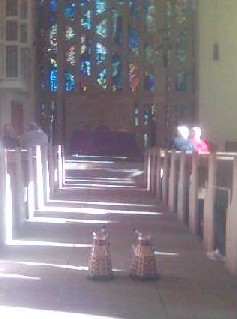 and Robert very kindly repaired it and brought it to church with him this morning. His son insisted on bringing theirs, so we had two daleks wandering up the aisle before the service. We did wonder what kind of response they'd get, but we need not have worried: they evinced a smile or a chuckle from everbody, from the very small children to the elderly. Robert's comment is notable: "...did you notice how everyone of whatever age hailed the Daleks' presence in Church this morning? Doctor Who is as trans-generational as the Church itself, and there aren't many other things you can say that about". He's right, too.
Sunday evening, and I feel as if my brain is made of fudge: thick and sticky. Although I have nothing more than a head cold, illness is always a source of immense frustration for me because it compromises efficiency. I started the weekend with a couple of lectures to write, one undergrad, one postgrad, and also my NoATE paper and a presentation for a job interview. The postgrad lecture was a doddle, and I've pretty well finished the undergrad one, but although the paper is in my head, I can't seem to make the words make sense on paper. And the job interview presentation will just have to wait until I can think more clearly. And so I get frustrated and miserable and sulk quietly, until a dear friend pops in for coffee bearing chocolate and sympathy and cheers up my evening.
Someone once send me a "Prayer for the Common Cold": it bears repeating here. Oddly enough, when I checked out my email archive, I find that the person who sent it to me is the same friend who called round this evening.
From 'The Prayer Tree' by Michael Leunig
God bless those who suffer from the common cold.
Nature has entered into them;
Has led them aside and gently lain them low
To contemplate life from the wayside;
To consider human frailty;
To receive the deep and dreamy messages of fever.
We give thanks for the insights of this humble perspective.
We give thanks for blessing in disguise.
Amen
Part of the reason I feel so terrible is that I haven't been sleeping very well, and last night decided to use the wakeful time in the wee small hours to finish a chore. I have been reading "The Da Vinci Code", only because I am so often asked my opinion thereof, and so I read for several hours to find out whether the book has any redeeming features. There are a lot of reasons that I was disinclined to like it, and to be fair, it wasn't all that bad as an adventure mystery for the lumpen masses.
But it is not a book for the literati: The characterisation is almost non-existent, and the prose is typical of the genre, devoid of elegance or charm. I found the puzzles very simple, and the solutions over-explained, but I suppose the target audience isn't really Guardian crossword afficionados. Grail mysteries of one kind or another are almost a genre in themselves, and if that were all there were to it, I would pass the book over as trivial but entertaining. What gets my goat is the gross misrepresentation of the development of Christology up to and during Nicea, presenting as fact things that have no basis in truth, and against which there is overwhelming evidence. To suggest that Christology was invented from nowhere by Constantine in 325 ignores 250 years of theology and doctrinal development, and disregards the witness of Paul, the author of Hebrews, Clement of Rome, Igatius, Justin Martyr, Irenaeus, Tatian, Tertullian, Origen, Arius and Athanasius, to name but few.
I've had the kind of week that reminds me why I love my job: students of one sort or another coming out of the woodwork, from visiting American urban ministry people to PhD candidates, Methodist vocational students and new undergrads. I ended up writing my ecclesiology lecture (L1) late the night before, and the session buzzed so I left work yesterday evening late but on quite a high.I've booked my ticket to London for a report launch: £8 return on a coach. Compared to £60+ on the train, it's a steal. And I booked in for the SST conference yesterday as well, the first time I've done a conference sponsored by my employer. I've yet to write my NoATE paper, but it will be done by the end of the week - I know exactly what I'm going to say, it's just a case of putting it on paper and assembling the Powerpoint slides.But I do need to do some serious writing. If I can finish off this term's lectures now, I could start putting together a proposal for publishing my thesis - or at least a *very* revised version thereof. My emails to the editor who asked about it before are bouncing, so I don't set too much store by her, but I do have contacts through a colleague with other editors who may be very interested.
This seems like as good a time as any to delete all my old posts and start again. I've finally finished my PhD, stopped feeling sorry for myself, and given up expecting a knight on a white charger any moment.Actually, it does feel like a time of change. I've been a student of one kind or another for almost exactly 13 years, and in that time I managed an Oxford first in Theology and a PhD. I'm about to draw finally an amicable but definite line under my marriage after two years separation. When I started studying, I was a single parent of 5 children: now I have just one teenager at home. I'm about to start a new stage in my career as a full time academic after years of part time, juggling and contract work. I'm looking forward to it all with some fear: can I really pull this off? But I'm also excited and hopeful and more contented than I have been for a very long time. I want to document this period in my life as it happens, because I know for certain it will look different with hindsight. I was looking at my teenage diaries yesterday, and as I read them, I knew what it felt like to be 14 again. Bearing witness is so much more important than remembering. Women of my age don't usually explore this kind of stuff in public.
 and can get on with some home improvements. I'm getting quite lightheaded (unless it's the tiredness, of course) over whether to have beech or maple cupboard doors, and the black sink I've chosen is to die for, dah-lings.


